
Resources
Help & articles
Guides, how-tos and news for your catering business.
Help topics
CRM
CRM Boards
The five CRM boards — inbound enquiries, outbound opportunities, and quotes pending, lost and won — and what each tells you about your pipeline.
Every enquiry, opportunity and quote sits on one of five boards. Two of them, Quotes lost and Quotes won, also tell you what your quoting is actually worth.
The Five Boards
Open CRM from the main navigation. The boards are split into two sets, because leads and quotes are different kinds of work. View customers sits in the top right if you want the customer list rather than the boards.
Enquiry boards
- Enquiries: inbound leads, where the customer came to you. Online form submissions, plus anything you logged from a phone call, email, referral or walk-in.
- Opportunities: outbound leads, where you go after the work. A customer’s regular annual function, an anniversary, a likely repeat booking. See Opportunities for how these differ.
Quote boards
- Quotes pending: raised, sent, and still with the customer. This is your live chase list.
- Quotes lost: declined, expired, or still pending after the expiry date has gone by.
- Quotes won: accepted.
Each tab carries a count, and the board you were last on is remembered, so a refresh puts you back where you were working rather than at the start.
Narrowing a Board
Two filters sit above every board, and both are remembered between visits:
- Tag: show only the enquiries, opportunities and quotes carrying one of your tags, such as Wedding or Corporate. The tab counts, and the figures on Quotes lost and Quotes won, follow it too, so you can see how your weddings are converting on their own.
- Account manager: any team member, All managers for the lot, or Unassigned to find the work nobody has picked up. On enquiries this reads the assigned manager; on quotes it reads the quote’s manager.
Tags and Managers on Each Row
Every row has a Manager column and a Tags column next to the name, so you can sort out who owns a lead and what kind of job it is without opening anything. Click the dashed button (or the manager and tags already there) and pick from the list. For tags, click one to add it, click it again to take it off, or type a new name to create it. The board updates as soon as you choose. See Tags.
On the Enquiries and Opportunities boards, clicking anywhere else on a row opens the enquiry. On the quote boards, clicking a customer name opens a panel over the board rather than navigating away. If that quote started life as an enquiry, you get the enquiry’s panel, so the whole history of chasing that prospect stays in one place no matter which board you meet them on.
Working an Enquiry
An enquiry that came through one of your online forms arrives on the board already filled in. One that came by phone, email or word of mouth you log yourself: click New enquiry and take down whatever the customer gave you. It does not have to be complete. The point of capturing it as an enquiry first is that whoever answers the phone can get the essentials down and hand it on, and the person who prices it picks up a record rather than a message on a notepad.
An enquiry is not a quote yet, so the panel is built for gathering rather than pricing:
- Notes: what was said, what they are still deciding, what the chef came back with.
- Attachments: their brief, a run sheet, a floor plan, last year’s menu.
- Emails: send from the enquiry itself, brochure attached if you like, and every one you have sent stays on the record.
- Follow-up reminders: as many as the lead needs, each one able to email you, a colleague, or nobody at all.
Email here is outbound only. A customer replying goes to your normal inbox, not back into Puree, so when they answer, paste what they said into a note and the thread stays with the enquiry.
Two Puree AI buttons sit above the note box for exactly that job. Scan email takes a pasted email trail, however long and however messy, and turns it into a short note with the catering-relevant details pulled out. Scan document does the same for a PDF or an image: their brief, a planner’s timeline, a dietary list. Both cost AI credits and both leave you a note you can edit before you keep it.
When the enquiry becomes a quote, none of this is left behind. The quote carries an Enquiry tab down its right edge, and one click reopens the original brief and everything recorded against it. Months later you can still see what they first asked for. Full detail in Processing Enquiries help page.
Working an Opportunity
Opportunities are the same panel with one difference that matters: nobody is waiting on you, so nothing will remind you unless you set the reminder yourself. That is what the board is for. Give it a date and it prompts you when it is time to make the call.
The quickest way to fill it is from work you have already done. Open last year’s order and choose Log repeat opportunity: the customer, contact and event details come across, and the opportunity keeps a link back to the job it repeats, so when you quote it you can see what they had and what they paid. Do it as you close each event off and next year’s pipeline builds itself. See Opportunities help page.
Chasing a Pending Quote
Quotes pending works the same way, because a quote sitting with a customer needs chasing just as much as a lead does. Open one and you get its notes, the emails you have sent it and its follow-up reminders, all on the record rather than in somebody’s head. Book several reminders on the one quote if it warrants them: a nudge a few days out, another the week the price expires.
This is the board that feeds the other two. Every quote here eventually lands on Won or Lost, and how diligently it is chased is usually what decides which.
Quotes Lost and Quotes Won: Choosing a Period
Quotes pending is a queue of what is next. Lost and Won are a record of what already happened, so both open with a period selector: 30 days, 60 days, 90 days, 6 months, 12 months or All time. It starts at 90 days and remembers what you pick.
Everything on the board answers over that period: the tab count, the headline figures, both charts and the table beneath them. The count on the tab and the chart above the table are always reading the same set of quotes, so they cannot disagree with each other.
What the Lost Board Tells You
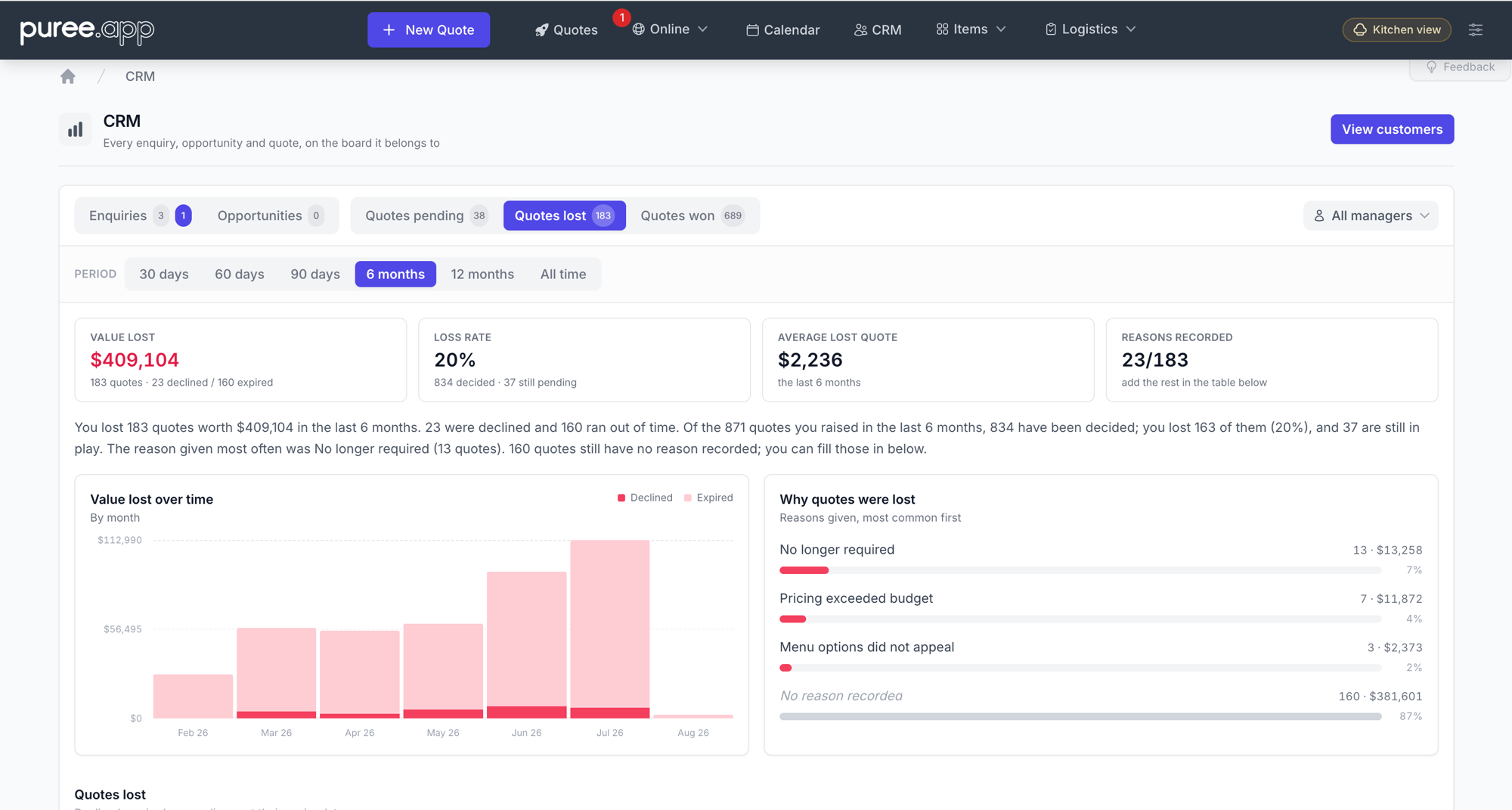
Four headline figures sit above the table:
- Value lost: what the quotes in this period were worth.
- Loss rate: the share of quotes that went against you.
- Average lost quote: useful next to the average booking on the Won board. If you consistently lose bigger jobs than you win, that is a pricing conversation.
- Reasons recorded: how much of the picture you actually have.
Each figure carries the working underneath it, so you are never left guessing what it is made of: how many quotes, how many declined against expired, how many have been decided against how many are still pending.
Beneath them, the same information is written out as a sentence you could read aloud in a meeting, along the lines of: You lost 183 quotes worth $409,104 in the last 6 months. 23 were declined and 160 ran out of time. Of the 871 quotes you raised in the last 6 months, 834 have been decided; you lost 163 of them (20%), and 37 are still in play. The reason given most often was No longer required (13 quotes). 160 quotes still have no reason recorded; you can fill those in below.
The timeline chart splits each bar into Declined and Expired. That distinction matters: a declined quote is a customer who answered you, while an expired one usually means nobody followed up in time. A tall expired bar is a process problem, not a pricing problem.
Underneath, Why quotes were lost ranks the reasons, most common first. This one is measured by count, because you want to know which objection keeps coming up.
Expired / no reason given covers the quotes that simply ran out of time, and it ranks on size like any other row. On most accounts it is the tallest bar on the chart, which is worth seeing rather than hiding: it says the work is being lost to silence, not to price. Below everything sits a greyed No reason recorded for declined quotes nobody has annotated yet. That one is the row to shrink, so it never leads however big it gets.
Recording Why a Quote Was Lost
A customer who declines online can pick a reason, but plenty skip the question, and a quote that simply expired never had one to give. So the Reason cell on the Lost board is editable. Pick from the same list the customer sees:
- No longer required
- Pricing exceeded budget
- Menu options did not appeal
- Received a more competitive quote
It saves the moment you choose, with nothing to submit. Because the customer’s own answers and yours come from the same list, the breakdown stays on one vocabulary and the bars remain comparable. If you learn the real reason on a phone call a week later, add it then and the chart updates.
Adding Your Own Reasons
Those four cover most of it, but not everything. A date that was already taken, a customer who decided to bring it in-house, a job that moved to another city: if you keep writing the same thing in the notes, it belongs in the list instead, where the chart can count it.
Go to Settings → Account Details and add them under Your own decline reasons, one per line. They then appear everywhere a reason gets picked: the Reason cell here, the customer’s own decline form, and the Mark quote declined action below.
Keep the list short, and avoid adding a reason that means much the same as one already there. Two labels for one objection split it across two bars, and neither ends up looking as important as the objection really is.
Declining a Quote Yourself
Most customers who say no say it by phone or email, not by clicking Decline on the quote. You can record it yourself: open the quote and choose Actions → Mark quote declined.
Pick a reason, add a note if there is anything worth remembering, and the quote moves to Lost exactly as it would have if the customer had declined it themselves. The reason is stored against the quote, so it counts on the Lost board straight away, and it stays editable in the Reason cell here (a reason the customer gave you themselves is a record of what they said, so that one is read only).
Everything that follows a decline follows this one too: scheduled card payment requests are cancelled, any linked calendar entries update, and cancellation tasks are raised for staff rosters and supplier orders on the accounts that use them.
Does the Customer Get an Email?
Only if you ask for it. Beneath the reason sits a tick box, Email … to confirm the quote is declined, and it starts unticked, because the customer is the one who told you no. Tick it if you would like them to have the same written confirmation the online Decline button sends them. If your Quote declined notification is set to reach your team only, it says so there, so you are never left thinking a customer was written to when they were not.
Changing Your Mind
A decline recorded in error is not the end of it. Actions → Re-open quote puts it back to pending, and it leaves the Lost board. This works for a quote the customer declined online too, so a customer who comes back a week later does not need the quote rebuilt.
Leads That Never Reached a Quote
Plenty of work is lost before a quote exists at all: the customer books elsewhere, the date is already taken, the budget was never going to work. None of that shows up in the figures above, because there is no quote to count. So the enquiry and opportunity panels carry a Not proceeding option beside Convert to quote.
Choosing it opens a short form: pick why it stopped, add a note if there is anything worth knowing, and close it off. The lead leaves the board, the reason stays on its record, and it appears on the Lost board. The reasons are the ones that apply before a quote exists, which is why they are not the same four a customer picks when declining:
- Went with another caterer
- Budget too low for the job
- We’re not available on the date
- Outside our service area
- Not the kind of work we take
- Event cancelled or postponed
- No response from the customer
- Duplicate or spam
- Other
Two things on the Lost board read them. Why enquiries stopped before a quote sits beside the quote reasons as a second breakdown, counted rather than priced, since these leads were never given a figure. And the Showing toggle above the table flips it between Quotes and Leads, so the same board lists either what was turned down or what stopped earlier, over the same period. Each side of the toggle carries its own count.
If a lead comes back to life, Reopen on its row puts it back on the Enquiries or Opportunities board and clears the reason, so nothing is counted as lost while it is being worked again.
What the Won Board Tells You
The same shape, reading the other way: Value won, Win rate, Average booking, and Still in play for the quotes from this period that have not been answered yet.
Where the wins came from breaks the period down by type of job, and this one is measured by value rather than count. Eight deliveries and eight staffed events are the same number and nothing like the same business, so counting them would flatten exactly the difference you are looking for.
How the Win and Loss Rates Are Worked Out
Both rates are asked of the quotes raised in the period, not of the decisions that happened to land in it. That is the honest way to read a quarter: it tells you how the work you sent out that quarter actually went.
Quotes still waiting on an answer are held out of the rate and reported next to it, in the form 28 decided, 12 still pending. A period full of unanswered quotes therefore neither flatters the number nor dents it. As those decisions come in, the rate settles.
Reading the Table
- Rows are sorted by the most recent decision first, so the freshest outcomes are at the top.
- Each row shows what the quote was worth and the date it was decided.
- A quote that is still pending but past its expiry date is badged Expired, because that is what it is to the customer.
Worth being clear about which date you are looking at. On Lost and Won the column is Lost on or Won on: the day the customer accepted or declined, not the day of the event. That is deliberate, since these boards measure your quoting rather than your calendar, and a Christmas function won in June belongs in June. The event date is still there in the row’s panel. Everywhere else, Enquiries, Opportunities and Quotes pending, the date column is the event date, because that is the one that matters while the job is still live.
The figures and charts are calculated when you open the board rather than kept in advance, since every quote in the window has to be priced to produce them. On a wide period such as All time, expect them to appear a moment after the table.
Getting the Most Out of It
- Fill in a reason on every lost quote you know the answer to. The breakdown is only as good as what has been recorded, and Reasons recorded tells you how far off you are.
- Watch the declined and expired split before you change your prices. Losing on price and losing through silence need very different fixes.
- Compare average lost quote with average booking. It is often the clearest signal of where your quoting is strong.
- Use the same period each time you review. Switching windows between reviews makes two numbers look like a trend when they are not.